ITALIAN DESIGN MATERIALS IN VIETNAM — THE COMPLETE 2026 GUIDE
Vietnam's luxury residential and hospitality sector has reached a turning point. Architects, interior designers, and developers across Ho Chi Minh City and Hanoi are specifying Italian design materials at a pace that would have been unimaginable a decade ago. The combination of the EU-Vietnam Free Trade Agreement (EVFTA), rising client expectations, and a new generation of design-literate private clients has made Italian sourcing not just desirable — but commercially viable.
This guide covers everything you need to know about sourcing Italian design materials in Vietnam in 2026: the full product landscape, logistics and lead times, customs and duty structures, and the factors that determine whether a project succeeds or fails at the finish line. It is written for architects, interior designers, developers, and private clients who want clarity on a market that has historically lacked it.
Nora Design Italiano (N_DI) is an Italian luxury design materials specialist with commercial operations in Thao Dien, District 2, Ho Chi Minh City. The company's technical heritage traces to Sassuolo, Modena — Italy's ceramics capital — since 1968, with operational capabilities that span sourcing, logistics, customs compliance, and last-mile delivery across Vietnam and Southeast Asia.
THE EVFTA ADVANTAGE — WHY ITALIAN MATERIALS ARE NOW MORE ACCESSIBLE
The EU-Vietnam Free Trade Agreement, fully in force since 2020, has fundamentally changed the economics of European material imports into Vietnam. Under EVFTA, most Italian ceramic tiles, natural stone, wood flooring, and wellness equipment now enter Vietnam at significantly reduced duty rates compared to the standard MFN (Most Favoured Nation) tariffs.
For ceramic and porcelain tiles, EVFTA rates typically range between 0% and 5%, compared to MFN rates that can reach 15% to 30% depending on the HS classification. For natural stone products, similar reductions apply. For wellness equipment — saunas, steam rooms, hydrotherapy systems — EVFTA has made previously cost-prohibitive Italian products accessible to the premium residential and hospitality segments.
The practical implication is significant. A project specifying €50,000 in Italian ceramic tiles can see import duty savings of €7,500 to €10,000 compared to sourcing from non-EVFTA countries at equivalent quality. For large-scale developments, these numbers are material. Any specification sourced through an authorized Italian operator with correct HS code classification and documentation will benefit from EVFTA rates automatically — but only if the import documentation is managed correctly by an experienced operator.
ADVANCED CERAMIC AND PORCELAIN — THE BACKBONE OF ITALIAN DESIGN SOURCING
Italy produces approximately 30% of the world's premium ceramic and porcelain tiles. The Sassuolo-Modena district, known as the "ceramic valley," has been the global reference for large-format slabs, thin panels, outdoor porcelain, and artisanal decorative surfaces since the 1960s.
In Vietnam, Italian ceramic and porcelain is specified across every tier of the premium segment: luxury villa bathrooms and living areas, five-star hotel lobbies and spa facilities, high-end retail and commercial interiors, and bespoke residential kitchens and outdoor terraces. The durability characteristics of Italian porcelain — frost resistance, UV stability, acid resistance, mechanical strength — make it particularly well-suited to Vietnam's tropical climate, where competing materials often fail within five to ten years.
Living Ceramics produces some of Spain's — and the world's — most architecturally refined ceramic surfaces, with collections that interpret natural stone, concrete, and metal in large-format porcelain. Lithotec specializes in ultra-thin porcelain panels with minimal grout joints, increasingly specified for seamless wall and floor applications in luxury interiors. Mutina, designed in collaboration with architects including Ronan and Erwan Bouroullec and Patricia Urquiola, occupies the highest tier of artistic ceramic production. Gigacer pioneered large-format ultra-thin porcelain, now a standard reference for contemporary slab applications.
Leonardo and LaFaenza — both part of the Cooperativa Imola group — offer comprehensive collections spanning traditional and contemporary aesthetics, with strong technical certifications for commercial use. For decorative and artistic ceramic surfaces, Ceramica Bardelli maintains one of Italy's most distinctive design archives. The landscape of Italian ceramic available through N_DI covers every specification requirement from residential to contract.
ITALIAN NATURAL STONE — MARBLE, TRAVERTINE, AND THE ARCHITECTURE OF PERMANENCE
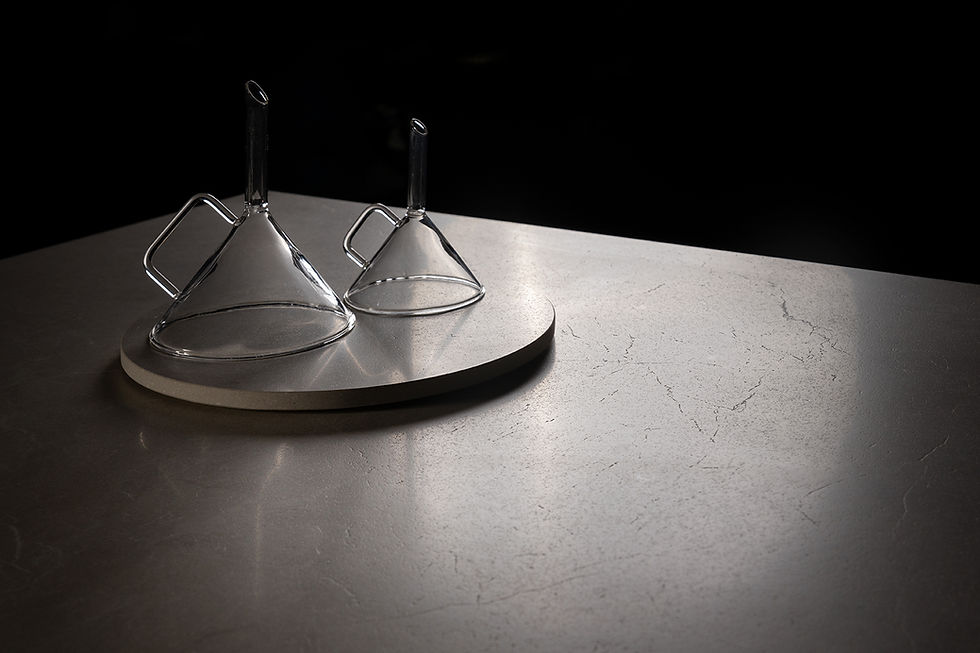
Natural stone from Italy is among the most enduring specification choices in luxury architecture. Carrara marble, Calacatta, Travertino Romano, Pietra Serena, Basaltina — these are not simply materials. They are geological histories, each quarried from a specific site in Italy and possessing characteristics that no engineered surface can replicate.
Salvatori is the definitive reference for architecturally designed Italian natural stone. Founded in Pietrasanta, Tuscany, in 1946, Salvatori works with architects and designers of international standing — Kengo Kuma, David Chipperfield, Piero Lissoni — to develop stone surfaces that go far beyond traditional slab applications. Their collections include textured stone panels, three-dimensional wall surfaces, stone furniture, and complete bathroom environments. Salvatori stone has been specified in leading luxury hotels, private villas, and flagship retail spaces globally, and increasingly in Vietnam's premium residential and hospitality sector.
Margraf, headquartered in Chiampo (Vicenza), is one of Italy's largest natural stone processors. With quarries and processing facilities that handle over 80 stone varieties, Margraf supplies projects ranging from landmark public buildings to private residential commissions. Their technical capabilities include custom sizing, surface finishing (polished, honed, brushed, sandblasted, flamed), and CNC cutting for bespoke architectural elements.
In Vietnam's climate, natural stone specification requires careful consideration of maintenance protocols, sealing systems, and structural substrate conditions. The correct care and protection system — applied at installation and maintained over time — is the difference between a stone surface that ages beautifully and one that fails prematurely. N_DI works with FILA Solutions, the Italian specialist in stone and surface care, to ensure every natural stone project is protected from the outset.

MICROCEMENT AND CONTINUOUS SURFACES — THE ARCHITECTURE OF SEAMLESSNESS
The demand for seamless, joint-free surfaces has reshaped luxury interior specification over the past decade. Microcement — and its more sophisticated evolutions in acrylic resins, liquid metals, and mineral coatings — offers what no tile or slab can: a completely continuous surface that reads as a single material across floors, walls, and architectural elements.
NOVACOLOR is one of Italy's leading producers of decorative coating systems, with a product range that spans mineral microcements, acrylic seamless systems, metallic and oxidation finishes, and outdoor-grade continuous surfaces. Their WALL2FLOOR system is specifically engineered for floor-to-wall continuity in high-traffic environments, with slip resistance classifications and moisture resistance suitable for Vietnamese construction standards.
In tropical climates like Vietnam's, continuous surface specification demands particular attention to substrate preparation, humidity control during application, and the selection of systems with appropriate thermal expansion characteristics. NOVACOLOR products have been successfully applied in luxury residential and hospitality projects across Southeast Asia, with documented performance in high-humidity environments including bathrooms, pool decks, and exterior living areas.
Inkiostro Bianco occupies a distinct position in the wallcovering category: digitally printed bespoke wallpapers that can reproduce any image, pattern, or artwork at architectural scale, on substrates ranging from standard paper to fabric, metallic film, and wet-area-rated materials. For hospitality and high-end residential applications requiring a completely unique interior surface, Inkiostro Bianco represents a category of one.

ITALIAN WOOD FLOORING FOR TROPICAL CLIMATES — THE ENGINEERED SOLUTION
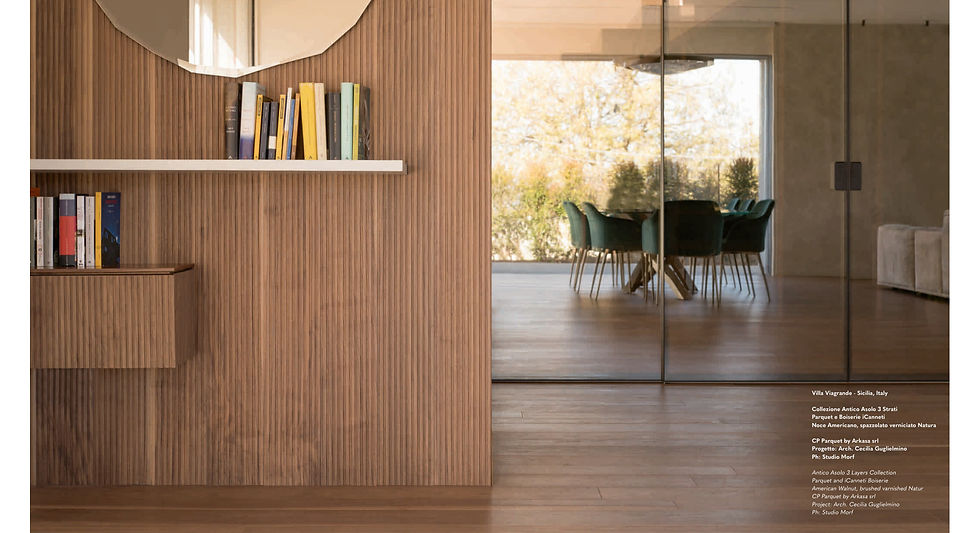
Solid wood flooring in tropical climates is a specification risk. The combination of high ambient humidity, air conditioning cycling, and seasonal temperature variation creates conditions that cause solid wood to move, gap, and warp. The Italian solution — engineered wood flooring with multi-layer construction and dimensionally stable cores — was developed precisely to address these conditions.
CP Parquet and Berti Parquet are two of Italy's most respected engineered wood flooring producers, with collections that span traditional European oak and walnut to exotic species, hand-crafted inlays, and large-format prestige planks. Both brands produce engineered constructions with structural cores that provide dimensional stability across the humidity ranges encountered in Vietnamese interiors — typically 65% to 85% relative humidity in Ho Chi Minh City's climate.
The selection of species, finish (oiled, lacquered, UV-cured), and plank format (width, length, thickness) requires project-specific guidance. A 200mm wide engineered plank with a 4mm wear layer and a spruce or poplar core behaves differently from a 300mm plank with a birch ply core. Lead time and custom production options — available for both CP Parquet and Berti Parquet — allow architects to specify precisely the dimension, species, and finish required rather than selecting from a generic stock range.

ITALIAN WELLNESS — SAUNA, STEAM, HYDROTHERAPY, AND PRIVATE SPA
The integration of wellness infrastructure into luxury residential and hospitality projects has accelerated significantly in Vietnam over the past five years. Private saunas, steam rooms, infrared cabins, and hydrotherapy systems are no longer exclusive to five-star hotels — they are increasingly specified in premium villas, penthouse apartments, and urban wellness facilities.
Italy leads globally in wellness infrastructure design and engineering. Starpool, based in Trentino, produces Finnish saunas, infrared therapy cabins, and biosauna systems with a design language rooted in Nordic minimalism and Italian craftsmanship. Their products are installed in leading spas, wellness centers, and luxury residences worldwide. Effe (Effegibi) specializes in high-design steam rooms, hammams, and chromotherapy cabins, with a product range that allows complete architectural integration — custom dimensions, finish materials, and lighting systems.
Treesse Group, Disenia, and Idea Group cover the full spectrum of luxury bathroom and bathing environments, from freestanding baths and architectural shower systems to complete wet room designs. CEA Design produces bathroom fittings — taps, mixers, showerheads — at the intersection of Italian industrial design and functional precision. Albatros/Megius Group specializes in whirlpool systems, minipools, and outdoor hydrotherapy, with products designed for both indoor spa environments and exterior installations in tropical settings.
The specification of Italian wellness in Vietnam requires particular attention to after-sales service, spare parts availability, and installation expertise. N_DI's referral network of qualified installation partners across Ho Chi Minh City and Hanoi addresses the critical gap between product specification and successful installation.

DECORATIVE PAINTS AND LUXURY METAL FINISHES
The surface finishing category — decorative mineral paints, metallic coatings, oxidation effects, special finishes — represents one of the most technically complex and visually impactful areas of Italian materials specification.
NOVACOLOR leads in mineral and acrylic decorative coatings, with a product range that covers interior and exterior applications, standard and custom colors, and finishes from matte mineral to high-gloss metallic. Their application systems are designed for professional use and require certified applicators — N_DI can provide referrals to qualified operators in Ho Chi Minh City and Hanoi.
Molteni Vernici specializes in liquid metal application systems — cold-applied metallic coatings that replicate the appearance of bronze, copper, iron, and brass on any substrate. The result is indistinguishable from real metal sheet but at a fraction of the weight and cost, with application possibilities on curved surfaces, furniture, and architectural elements that would be impractical with sheet metal.
DeCASTELLI produces architectural mosaic and metal surface systems — perforated and folded metal panels, corten, brass, and stainless steel surfaces — for wall cladding, ceiling applications, furniture fronts, and architectural dividers. Their systems bridge the boundary between surface material and structural element, offering a category of specification that has no direct equivalent from non-Italian producers.

LOGISTICS, LEAD TIMES, AND WHAT TO EXPECT
Sourcing Italian design materials in Vietnam requires a realistic understanding of the logistics chain. The standard route — factory in Italy, ocean freight to Ho Chi Minh City (Tan Cang/Cat Lai port), customs clearance, last-mile delivery — typically runs 10 to 14 weeks from order confirmation to site delivery for sea freight shipments.
For urgent specifications, air freight is available for smaller volumes — typically items under 200kg or 1 CBM — with lead times of 7 to 10 days from dispatch. The cost premium of air freight is significant and is usually justified only for replacement items, samples for approval, or very small quantities where the project timeline is critical.
Import documentation in Vietnam requires careful management. The correct HS code classification is essential for EVFTA rate application. Errors in classification result in MFN rates, incorrect VAT calculation, or customs delays that can add two to four weeks to the lead time. N_DI manages the complete customs declaration process for all shipments, including EVFTA certificate of origin verification and coordination with licensed customs brokers.
Pricing transparency is a non-negotiable principle of N_DI's operating model. Every quotation includes a complete breakdown of EXW product price, international freight (minimum to maximum range), estimated import duties and VAT, local charges in Vietnam, and N_DI's service fee. The total is presented in Vietnamese Dong at the day's exchange rate, with a stated variance of ±10-15% at estimate stage and confirmation prior to order commitment.
HOW TO WORK WITH N_DI — THE SOURCING PROCESS
The standard N_DI engagement begins with a specification brief from the architect or interior designer. Based on the brief, N_DI provides material recommendations across relevant categories, with product samples available for review at the showroom in Thao Dien, District 2, Ho Chi Minh City.
For confirmed specifications, N_DI prepares a detailed quotation with complete cost breakdown as described above. Samples can be ordered for physical review prior to specification confirmation — a symbolic fee applies, fully deductible from the final order. Technical documentation — CE marking, fire resistance certification, VOC emission data, installation specifications — is provided as standard for all products.
N_DI operates three client categories: Category A (NDI-approved special clients), Category B (professional businesses with Vietnamese tax ID), and Category C (private clients and shop customers). Each category has corresponding pricing structures that reflect the scale and frequency of engagement.
The company does not subcontract installation directly but maintains a referral network of qualified installation partners across Vietnam. For complex installations — microcement systems, natural stone with custom cutting, sauna and steam room assembly — N_DI coordinates the introduction to appropriate specialist installers.
Physical samples of all major product categories are available at the Thao Dien showroom. For architects and designers managing multiple active projects, a dedicated trade account provides priority access to new arrivals, technical consultation, and project-specific pricing.
FREQUENTLY ASKED QUESTIONS
What is EVFTA and how does it affect the price of Italian materials in Vietnam? The EU-Vietnam Free Trade Agreement (EVFTA), in force since August 2020, progressively reduces import duties on goods originating in EU member states, including Italy. For most ceramic tiles, natural stone, and wood flooring, EVFTA rates in 2026 are significantly lower than standard MFN rates. Correct application of EVFTA requires proper documentation — certificate of EUR.1 or origin declaration from the Italian exporter — and correct HS code classification. N_DI manages this documentation for all shipments.
How long does it take to receive Italian materials in Vietnam? Standard sea freight from Italy to Ho Chi Minh City takes 10 to 14 weeks from order confirmation to site delivery. This includes production lead time (if items are not in stock), transit time (approximately 30-35 days), and customs clearance in Vietnam (5-10 working days under normal conditions). Air freight for small volumes takes 7 to 10 days but carries a significant cost premium.
Can Italian materials perform well in Vietnam's tropical climate? Yes, with correct product selection and specification. Italian engineered porcelain (full-body, frost-resistant grades) performs excellently in tropical conditions. Engineered wood flooring with stable cores is the correct specification for Vietnam's humidity range — solid wood is not recommended. Microcement and continuous surface systems require certified applicators and correct substrate preparation for long-term performance in high-humidity environments. N_DI provides climate-specific specification guidance for every product category.
Is there a minimum order quantity for Italian materials? Most Italian suppliers operate with minimum order quantities that vary by product type and collection. For standard catalog products, MOQ typically ranges from 1 to 5 boxes for ceramic tiles and 10 to 20 square meters for natural stone. For custom production — specific dimensions, colors, or finishes not in the standard range — higher MOQs apply and extended lead times should be anticipated. N_DI clarifies MOQ and lead time for each specific product at the quotation stage.
Can I visit a showroom to see material samples before ordering? Yes. N_DI's showroom in Thao Dien, District 2, Ho Chi Minh City carries physical samples of key products across all categories. For products not in showroom stock, N_DI can arrange sample orders — typically delivered within 3 to 5 weeks for sea freight samples, or within 10 days via air freight for priority approval.
Nora Design Italiano — Italian luxury design materials for Vietnam and Southeast Asia. Showroom: Thao Dien, District 2, Ho Chi Minh City. Contact: designmaterials@noradesignitaliano.com
Explore our complete range of Italian surfaces and design materials and wellness solutions.