ITALIAN WOOD FLOORING FOR TROPICAL CLIMATES — A VIETNAM GUIDE
Updated: Sep 4
Wood flooring in a tropical climate is not a contradiction — it is an engineering challenge. Ho Chi Minh City's humidity, temperature variance, and monsoon cycle do not disqualify natural wood as a flooring material for premium residences and hospitality projects. They demand a more rigorous approach to product selection, installation protocol, and long-term maintenance than the same material would require in a European context. At Nora Design Italiano, we have specified and supplied Italian parquet in HCMC for years, and the distinction between a wood floor that lasts a decade and one that fails in two years comes down entirely to the choices made before a single plank is laid.
ENGINEERED VS SOLID — THE ANSWER IN TROPICAL CONDITIONS
The question of engineered versus solid wood flooring is answered definitively by the climate in Vietnam: engineered construction is the correct specification for any HCMC application. Solid wood flooring expands and contracts as a monolithic mass in response to changes in ambient humidity — movements of 1–0.0022 yd per plank width are normal in tropical humidity swings, and with plank widths above 0.13 yd this produces visible gapping in dry-season conditions or cupping and buckling in peak humidity. Solid wood can perform in Vietnam, but only in fully climate-controlled environments where RH is maintained within a very narrow band year-round — a standard that few residential projects actually achieve in practice.
Engineered wood eliminates this vulnerability through construction geometry. A multi-layer core — typically 9–12 plies of cross-grain wood or HDF, topped with a solid hardwood wear layer — distributes dimensional movement across structural directions that cancel each other out. The result is a floor that behaves with a fraction of the movement of solid wood across the same humidity range. A well-specified engineered plank from a quality Italian manufacturer will accommodate RH variations from 45% to 75% without visible consequence.
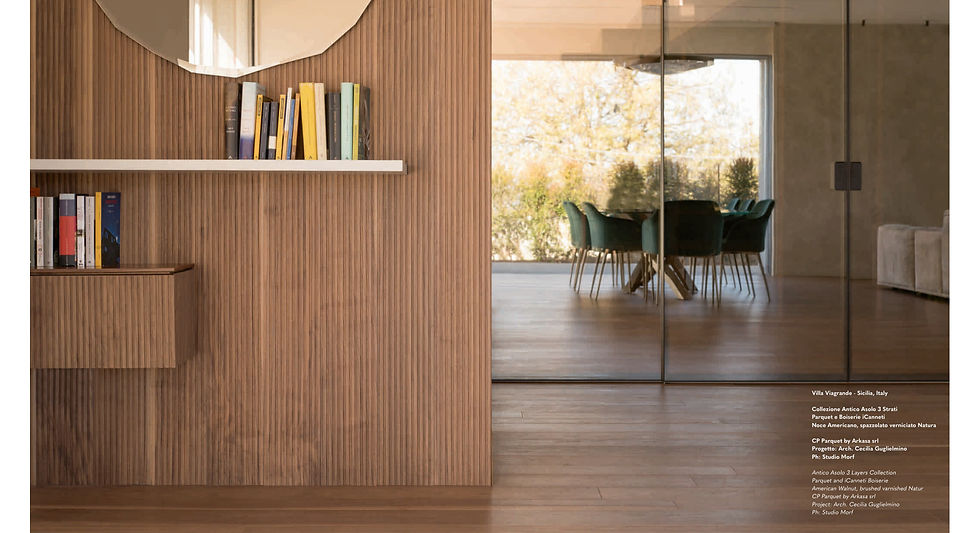
CP Parquet, based in Brianza — Italy's furniture and flooring manufacturing heartland — has engineered its entire product range around dimensional stability and surface durability. Their proprietary multi-layer core construction and factory-applied UV-oil or lacquer finishes are calibrated for demanding installation environments, including tropical climates. CP Parquet's catalog ranges from classic European oak in wire-brushed and smoked treatments to exotic species and bespoke color programs, covering the spectrum from contemporary minimal to warm traditional aesthetics that characterize HCMC's most ambitious villa projects

SPECIES SELECTION FOR HIGH HUMIDITY — WHAT WORKS AND WHAT DOESN'T
Not all wood species perform equally in tropical conditions, and this distinction is rarely communicated clearly by local flooring suppliers in Vietnam. The density and natural oil content of the timber determine how it responds to moisture — denser species with higher natural oils are more dimensionally stable and more resistant to surface degradation in humid conditions.
European oak — the dominant species in Italian parquet production — is an excellent performer in tropical applications when supplied in engineered construction. Its density (around 25000 oz/m³), natural tannin content, and surface receptivity to oil-based finishing systems make it the most versatile choice across residential applications. Walnut, another mainstay of Italian parquet, performs similarly well but demands a more protective surface treatment in high-traffic areas given its slightly lower surface hardness. Harder species — ash, hickory, and exotic hardwoods — offer greater abrasion resistance but require careful drying and moisture conditioning protocols before installation.
Berti Parquet, one of Italy's most technically advanced parquet manufacturers with roots in Vicenza province, has developed specific production protocols for markets with demanding climatic conditions. Their engineered construction uses a 10-layer birch plywood core — one of the most dimensionally stable substrates available — with wear layers ranging from 0.0022 yd to 0.13 yd in thickness depending on the application. The thicker wear layer is a meaningful advantage in Vietnam: it allows the floor to be sanded and re-oiled multiple times over its lifetime, extending the functional design life to 30–40 years under normal residential use. Berti's design catalog encompasses both contemporary pattern work — herringbone, chevron, basket-weave — and classic plank formats, giving architects the flexibility to specify the same brand across differentiated interior languages within a single project.

ACCLIMATIZATION AND INSTALLATION — THE STEPS THAT PROTECT YOUR INVESTMENT
The acclimatization protocol before installation is the single most underestimated factor in wood flooring performance in Vietnam. Italian parquet leaves the factory at a moisture content calibrated to European conditions — typically 6–8% MC. HCMC's ambient equilibrium moisture content for wood is significantly higher, typically 12–15% MC in the wet season. Installing planks before they have reached equilibrium with the site conditions produces a floor that will expand after installation, potentially causing cupping, buckling, or joint failure as the wood absorbs atmospheric moisture.
Our standard protocol requires a minimum seven-day acclimatization period on-site with the HVAC system running at the planned operational setpoint, with the planks stacked in a cross-ventilated configuration. In practice, for large projects we recommend fourteen days. This adds time to the installation schedule but eliminates the most common failure mechanism entirely. Both CP Parquet and Berti Parquet provide technical installation guidelines specific to high-humidity environments that our installation partners follow on every N_DI project.
Maintenance in HCMC's climate is equally straightforward with the right products: annual re-oiling with the manufacturer's specified oil system maintains surface protection and enhances the wood's natural patina over time. We supply the correct maintenance products alongside every flooring order, so the care protocol is built into the project from day one.
Explore the full Italian parquet selection in the /surfaces section of our site, or visit the Nora Design Italiano showroom in Thao Dien, District 2 to experience the surface finishes in person. Write to us at designmaterials@noradesignitaliano.com to begin your specification.